The Problem
- Field footage takes too long to become usable. Footage arrives from LiveU and Dejero units in the field and then sits waiting for a transfer to finish, a mirror to complete, or a manual relay to push it into the edit system.
- Search is where time disappears mid-story. In a breaking situation, nobody has time to scrub through raw rolls looking for the right quote, reaction, or archive clip.
- Multi-desk coordination fragments the footage. Digital, broadcast, and social desks all need the same story cut differently, on the same deadline. When footage can only move through manual exports, the whole process drags.
- After publish, the archive problem starts. Follow-up coverage, anniversary pieces, and breaking callbacks all depend on footage that can be retrieved fast. When the archive is disconnected from the active workflow, journalists skip context they already have.
What Aspect Does for Newsrooms
The gap between a story-centric newsroom and a siloed one is usually a workflow problem, not an editorial one. Aspect closes that gap by making footage usable the moment it's uploaded, searchable once it's processed, and reusable long after the story publishes.- Editors mount footage from field units and start cutting right away
- Producers search for quotes, reactions, archive moments, and public figures in plain language instead of scrubbing raw rolls or relying on logging notes
- Cold storage keeps years of journalism searchable and active rather than just sitting in an archive
The Solution
Mounted Access and Streaming
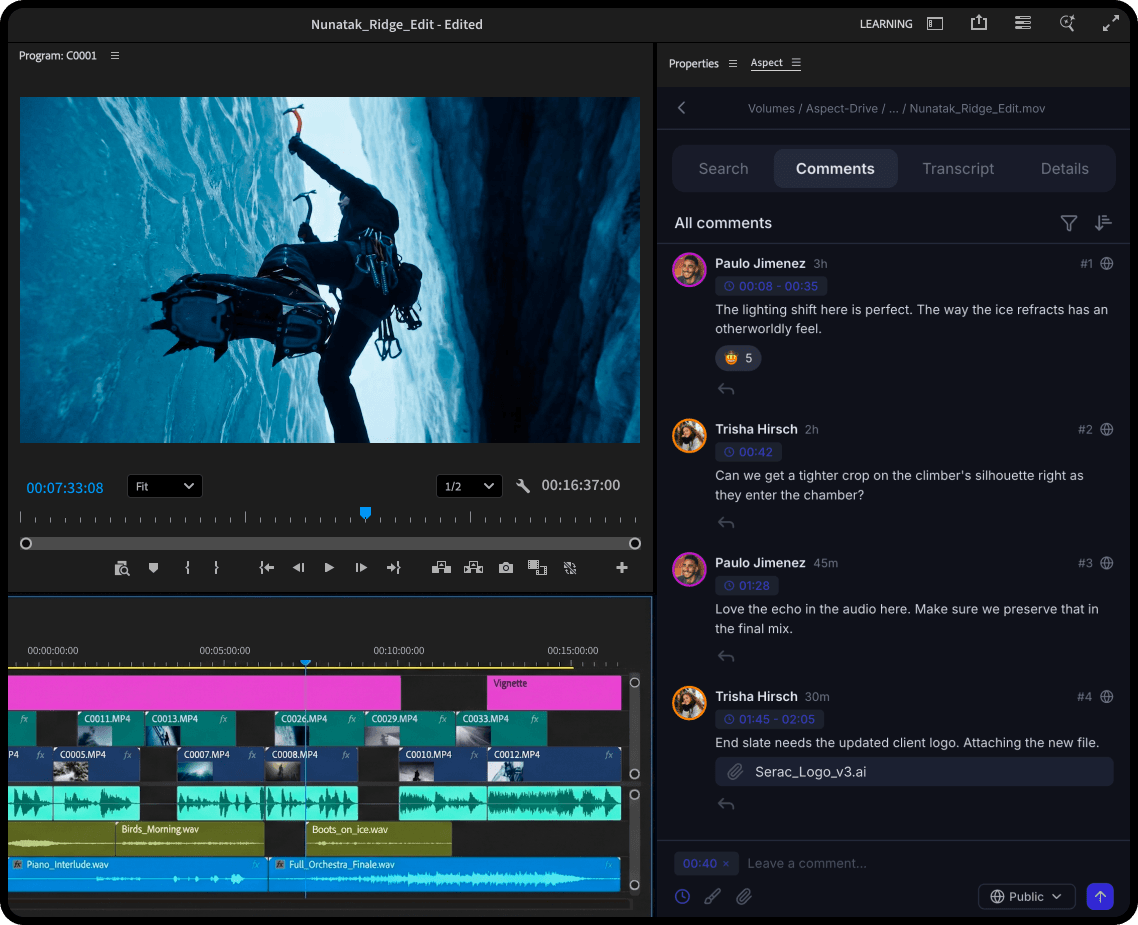
The biggest shift in modern newsrooms is the move from a broadcast-first, rundown-based model to a story-centric one, where the story itself is the organizing unit rather than the show or the airtime slot. Digital desks can't wait for a linear broadcast to finish before covering a breaking story. Field teams using LiveU and Dejero units are already transmitting footage in real time. The problem is what happens once that footage arrives at the station. Most newsrooms still route incoming footage through a transfer queue before any editor can open it. On a standard production day, that delay is manageable. During breaking coverage, that's where the window closes. Mounted access makes footage available the moment it's uploaded. An editor opens the project from a mounted drive and begins cutting against live-ingesting media. While the field crew is still shooting, the desk editor is already working. Compressing the time between ingest and the first edit is what makes a story-centric workflow real in practice, not just something people talk about wanting. For newsrooms running simultaneous outputs across broadcast, digital, and social, mounted access also removes the need for sequential handoffs. All three desks access the same mounted source at the same time.Transcription, Semantic Search, and Facial Recognition
A lot of newsroom speed comes down to search speed. A breaking political story needs archive footage from three years ago. If that archive can only be navigated by whoever logged it correctly, the journalist either spends an hour hunting or skips the context entirely. Transcription runs automatically as footage is processed, turning every interview, press conference, press briefing, and field report into a fully searchable text layer tied to the exact timecode. A producer looking for a specific quote from a city council hearing six months ago searches for it the same way they'd search a document, in plain language, and lands on the right moment in seconds. Semantic search goes further. A producer doesn't need to remember the exact phrase that was said. They can describe the moment and the search surfaces the right clip from across the entire library. For journalism, this turns the archive from a storage cost into an editorial resource that improves the quality of every story that touches it. Facial recognition adds another retrieval layer. Recurring public figures, interview subjects, reporters, and archive personalities are indexed automatically across current and historical footage.Shared Cache for Edit Suites
Broadcast newsrooms run multiple edit suites simultaneously, especially during breaking coverage when every desk is cutting a different version of the same story at the same time. Without a shared cache, each suite pulls the same footage independently from the source. During a major story with large file volumes, that repeated pulling compounds into real bandwidth drain and slower performance across every workstation in the building. A shared cache node deployed on the local network means the first suite to pull a file does the work for everyone else. Once one editor opens the raw footage from a city hall press conference or a courthouse arrival, that footage is cached locally. Every other suite on the same network reads it at full LAN speed, which cuts down on performance degradation.Cold Storage with Searchable Metadata
Newsrooms are unique in that their archive is active. When that archive sits in disconnected hard drives, deprecated MAM systems, or cold storage that strips the metadata, journalists lose access to their own institutional knowledge. The story goes out thinner than it should, or someone spends hours hunting footage that should have taken minutes to find. Cold storage in Aspect keeps older footage governed and searchable without occupying premium active storage. Transcription, facial recognition data, and custom metadata travel with the file into cold storage. For newsrooms managing years of election coverage, court reporting, investigative journalism, and ongoing beats, this is the capability that makes institutional knowledge compound over time instead of expiring.What a Workflow with Aspect Unlocks
| The Bottleneck | How Aspect Solves It | What Your Team Gains |
|---|---|---|
| Field footage from LiveU and Dejero units sits in a transfer queue before any desk editor can open it | All desks access the same source simultaneously, no sequential handoffs | The story-centric workflow becomes real in practice, with field to publish happening without waiting on file transfers |
| Producers scrub raw footage or rely on logging notes to find specific quotes, reactions, and archive moments under deadline pressure | Search by spoken word, described moment, or public figure across the full library | Journalists find any moment in seconds, which makes stories faster to develop and publish |
| Every edit suite independently pulls the same breaking footage from the source, competing for bandwidth and slowing performance across the building | A local cache node means the first suite to pull a file does the work for everyone | Multiple suites cut simultaneously during major coverage without the infrastructure slowing down as more editors join the story |
| Archive footage ages out of active storage or gets buried in disconnected MAM systems, making institutional knowledge inaccessible | Transcription, facial recognition, and metadata travel with footage into cold storage | Continuing a story is straightforward because past footage is easy to find, and storage costs go down |
Does Aspect Fit Your Newsroom?
Aspect tends to resonate with newsrooms where the workflow, not the editorial instinct, is what slows the story down:- Field teams transmit footage via LiveU or Dejero and desk editors still wait on a transfer before the edit can start
- Producers spend real time mid-story hunting for quotes, reactions, or archive clips that should be findable in seconds
- Broadcast, digital, and social desks all need the same story cut differently and currently get there through sequential handoffs rather than simultaneous access
- The archive holds years of ongoing beat coverage that are too buried or too expensive to retrieve quickly